RIP CURRENTS & CURRENTS
A mass of water moves up the beaches in the form of waves. This water is now higher than sea level and the laws of gravity dictate that this mass of water has to return back to sea level. This mass of water will find the ‘path of least resistance’ (the easiest way to flow back out). If you had for example, a sloping beach, a rocky headland or flat, smooth harbour wall… this mass of water would flow down the slope/along the flat, hard surface that offers little resistance and it’ll start flowing out. As the water continues to follow this pattern, the rip current starts to dredge sand off the sand bank and creates a deeper, darker channel.
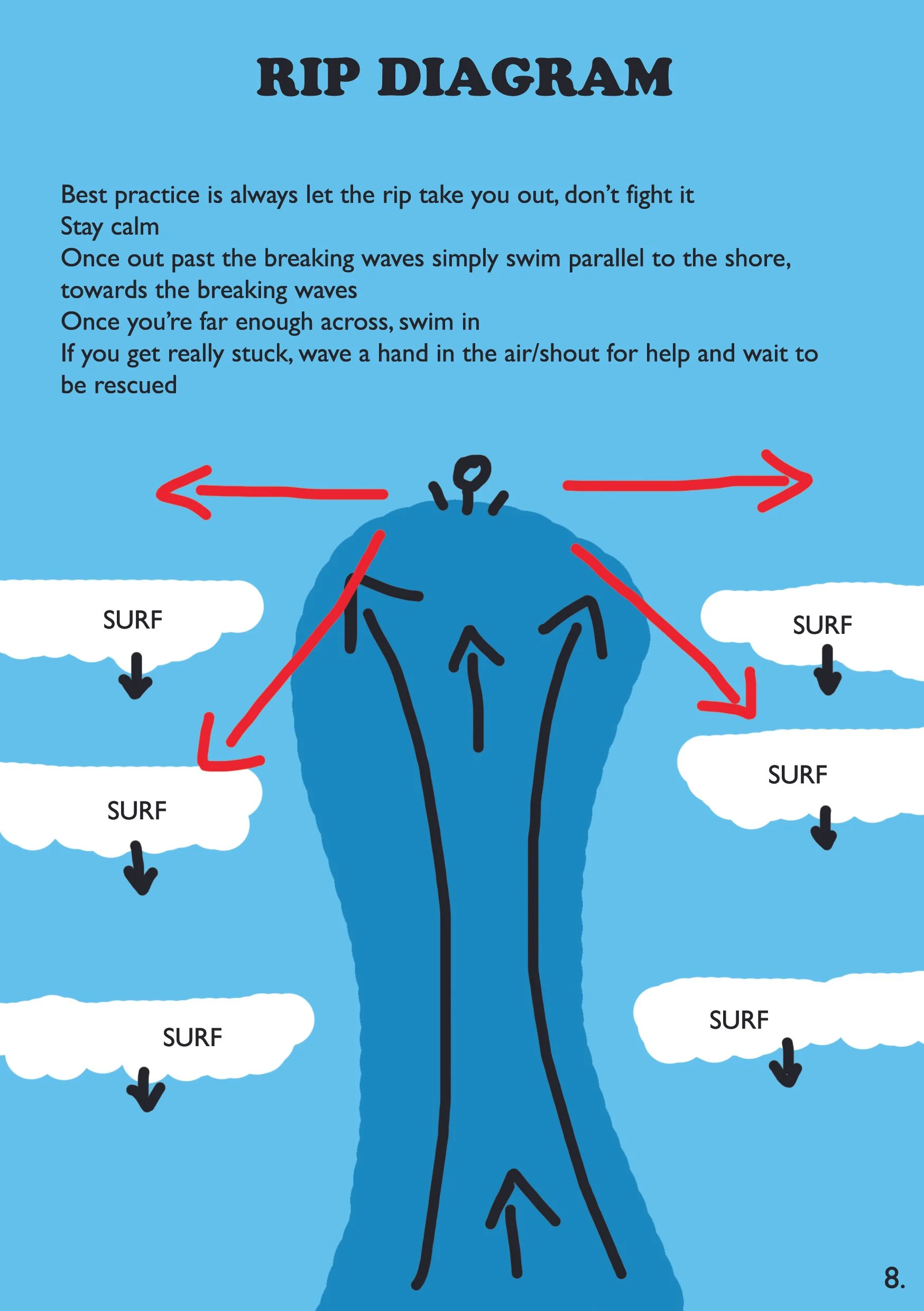
KEY FACTS AND INFO ABOUT RIP CURRENTS :
‘Rips’ generally only move just past the breaking waves. Rips typically don’t drag you miles out to sea.
The strength of a rip is generally determined by the size of the surf.
In ‘reasonable’ size surf, rips aren’t often that wide. Most rip currents will only be between 5-10m wide.
The position of rip currents will vary depending on the state of the tide.
‘Rip tides’ don’t exist. It’s a rip current.
The length of a rips life can vary significantly. You can have ‘flash rips’ that only last minutes or hours, right up to permanent rips…which will potentially last hundreds of years.
Rips will often be stronger under a spring tide ie. due to the quantity of water moving.
Rips will often look like flat, calm sections of the beach.
Rip currents are responsible for around 80% of lifeguard rescues.
Much like the diagram above, rips very often don’t run out to sea in a straight line. They’ve often run out at an angle.
PANIC!
We personally feel that panic is the number one killer in the sea. Whilst lifeguarding we’ve lost count of the number of times we’ve witnessed surfers/water users stuck in a rip current, who ditch their floatation device (surfboard, body board…) and try and swim in. Sadly, there have been drownings where people are recovered from the water with a board still attached to the swimmer via the leash.
Once panic sets in, people stop thinking logically and start making bad decisions. Staying calm is key and far simpler said than done.
Part of staying calm is taking time to plan your route/swim, having a back-up route/plan, understanding the conditions and how rip currents and currents work is a key part of this process…and knowing how to signal for help.
Another part of the process is reading the conditions and swimming in the right places, at the right time.
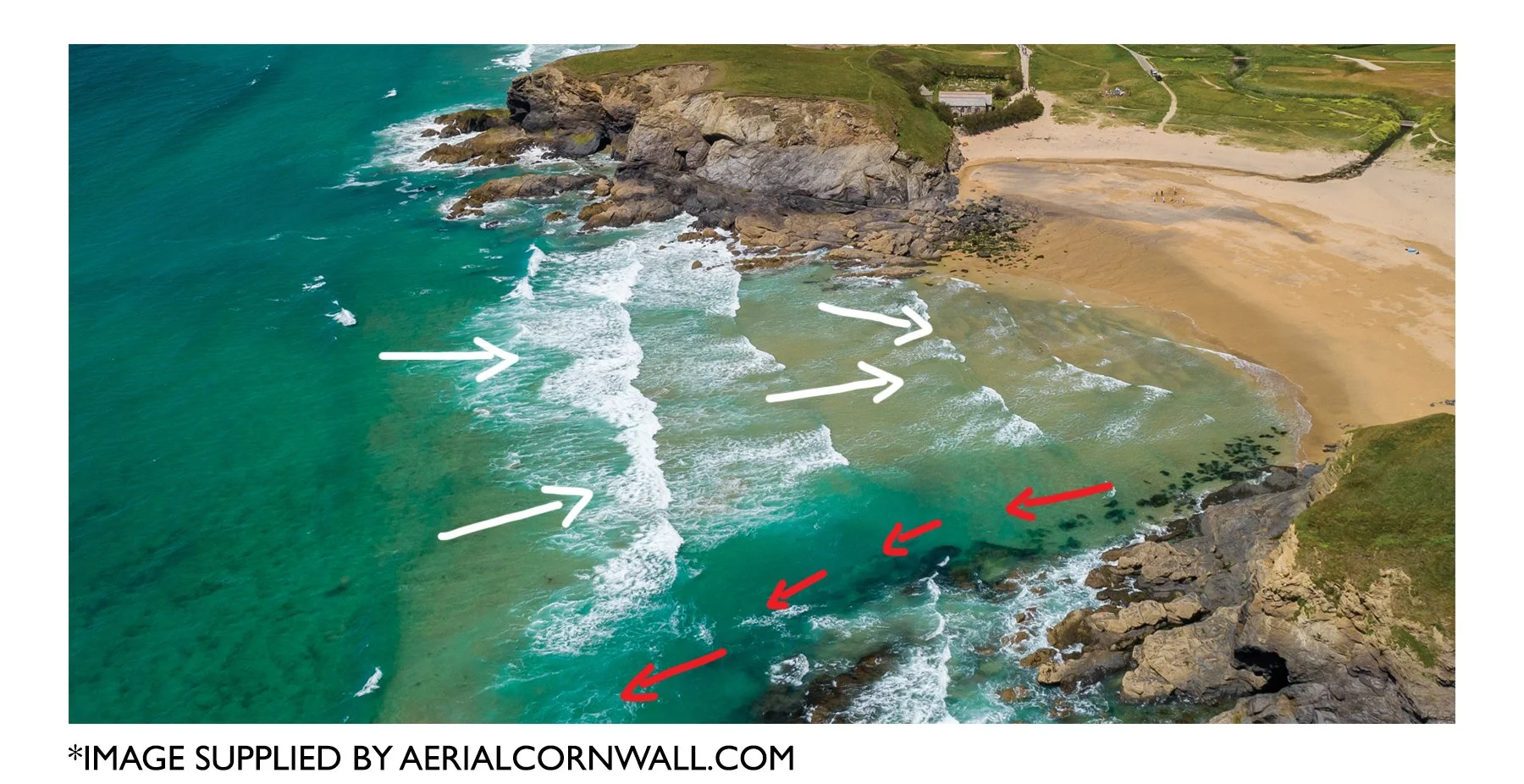
* In the diagram, the mass of water (represented by the white arrows), flows up the beach in the form of waves, once on the beach that ‘mass’ flows back down the beaches sloping surface (due to gravity), to the rocks and then flows back out (red arrows).
SPOTTING A RIP :
As there’s a deep channel the water will be a darker colour, as the water is deeper waves don’t tend to break in a rip (nice calm looking water), you may see debris and seaweed being dragged out & the water will also look discoloured (due to the dredging).
As rocks and hard surfaces offer up little resistance to the flow of water, you’ll often get ‘permanent rips’ moving along harbour walls, cliffs/headlands and hard surfaces.
It’s well worth pointing out that rip currents can and will change position, based on the state of the tide. So you may well turn up and identify the rip currents on arrival, but that isn’t to say that they’ll be in the same position when you’re finishing your swim.
VISUAL EXAMPLES
Example 1 : I’m going to use videos to go over rip currents and rip current identification, before then explaining how rip currents work. We’ll start by looking at a straight forward rip current at Perranuthnoe Beach, in west Cornwall. Generally, with no swell Perranuthnoe can be a very safe beach to swim at. However, add a few waves and it can be quite the opposite. They do have lifeguards for the 6 peak weeks of the summer. As you can see in this example. As well as rip on the west side of the beach, there was also a diagonal rip on the east side.
Now in this example, the rip runs from around waist height in the water, right out just past the breaking waves. It runs near the headland. Rips will often run along headlands, harbour walls, rocky surfaces, as the smooth rock offers less resistance and the water flowing back out to ‘sea level’ will always follow the path of least resistance.
What this video does highlight very well and this is generally the case…is that you rarely find rip currents where there is a consistent breaking wave. This is because the depth of the sand creates the waves…whereas rip currents tend to dredge water off the bottom as the water flows out and this creates a deeper channel. This is why waves don’t break in rips. In some instances, they will break further out and then peter out as the wave travels over the deeper section of rip current. This video demonstrates this very well.
Example 2 : Now this isn’t your text book rip current and that’s what I like about it. Most rip diagrams show you a perfectly formed rip, running at 90 degrees to the beach. More often than not, rips don’t follow this pattern. They come in all kinds of weird and wonderful shapes and can change shape and strength, depending on the conditions, tidal movement etc.
In this instance, you have a deep(er) ‘trough’ and diagonal rip current which leads onto a shallower bank, where some waves are breaking. This wouldn’t be the worst rip in the world for swimmers, as it would simply push you down the beach (from right to left), onto a shallower bank…where you should be able to get in fairly easily. *It would be more of a problem for children and poor swimmers, as it would carry them out of their depth fairly quickly and induce panic. It would also carry you into the bigger waves, which again can cause panic and issues for less experienced swimmers.
In this example, had the tide been 15-20m higher, this rip current would be much stronger and would lead it’s victims out just past the breaking waves, into deeper water. It’s also worth bearing in mind that if the tide was 20-30m further out (towards low tide), this rip current would simply be dry sand and wouldn’t cause any problems at all. Be aware that rip and their position do change with the tide. The position of rip current on a beach between high and low tide for example, can be very different.
EXAMPLE 3 : Saw this whilst exploring some coast I’m not as familiar with as I’d like. Great example of a rip current (and a strong backwash/surge).
The biggest danger here are actually wave surges up the beach and the backwash. Dog walkers or walkers not paying attention, getting knocked over fully dressed and rolling down the beach! If you look at the conditions, it’s unlikely anyone would pop in for a swim…and if you did, the 4-6 foot shorebreak, breaking in 6 inches of water would be your main concern. The rip currents only go out just past the breaking waves…so are actually fairly tame…in isolation.
Rip currents are bodies of water that find themselves above sea level. In this example, a wave having flown up the beach. Once above sea level, the laws of gravity will dictate that this body of water returns to sea level. The body of water in question will naturally find the path of least resistance. On the video (although you can’t see it), there is a stream on the far right, flowing into the sea. This stream gauges a channel out of the beach and creates a natural flow of water into the sea… so you find a rip current here. The slopes either side of the stream encourage the water to flow down hill and the sea water joins the stream and flows out nice and easy. In the middle of the frame you see another rip current. The beach slopes into a slight valley (in the middle of the beach) and the water again, flows down the side of this ‘valley’ and out. The more water that does this, the more this valley has sand carried out with the current and the deeper this ‘valley’ becomes.
*There are actually 3 rip currents just in frame, one on the near side…but I didn’t want to make this article too confusing. You wouldn’t normally get 3 rip currents so close together but there is such a mass of water flowing up the beach with the swell and the beach is so steep, that the water returns back out to sea at high speed…if the waves were breaking further out, some of this energy would disperse naturally on the way in.
EXAMPLE 4 : a good example of a rip in miniature. In this video we walk you through a mini-rip, which demonstrates really well how a rip current works.